This excellent Hispanic genealogy book (Spanish text) is entitled the origin of the founders of Cadereyta. Guillermo Garmendia Leal begins his genealogy book with a brief introduction, a list of abbreviations used and listing the events (1635 – 1639) surrounding the initial founding of San Juan Bautista de Cadereyta on 8/13/1637 and 2/25/1638. Then he provides ancestry documentation and descendant charts of ten of the founding families (see table 1) of San Juan Bautista de Cadereyta. Guillermo Garmendia Leal then follows by a listing of Cadereyta elected officials and elected dates of officials from 2/25/1638 to 1/1/1745.
| Founder | Wife | Came From |
|---|---|---|
| Juan Alvarez De Godoy | Maria Perez Soria | Huichapa, Jilotepec |
| Alonso De Leon Capitan | Josefa Gonzalez (De Leal) | Huichapa, Jilotepec |
| Jose De La Garza Falcon Capitan | Josefa Gonzalez De Leon [Maria De Solis] | |
| Sebastian Garcia | Maria Navarro | Serpa, Portugal |
| Diego De Solis Caudillo | Maria De Mendoza | |
| Juan Mendez Tovar | Leonor Pinto [Maria Perez] | Huichapa, Jilotepec |
| Francisco Perez De Escamilla Lieutenant | Tepetitlan | |
| Pascual De Montalvo | Maria Rangel | |
| Sebastian Perez De Gumendio Yrigoyen Notary | Elena De La Garza | |
| Juan Lopez De Jaen Capitan | Michaela De Rivera | Huichapa, Jilotepec |
Table 1. This table shows ten San Juan Bautista de Cadereyta Founders whose families and ancestry are described in this genealogy book. The first column displays the Founders name, surname and title or profession. The second column displays the wife’s name and surname; while names in brackets are the wife from other marriages. The last column describes where the founder came from.
Guillermo Garmendia Leal extracts the genealogy records of the book ‘Foundation of the Brotherhood of Nuestra Senora Del Rosario’. The ancestry records from this book provides a listing of brotherhood membership, elected members, donations, and the date of memberships starting from1666 to 1761. This would be useful for anyone tracking their Hispanic ancestor’s presence in this community for the years covered.
One of the best features of this genealogy book is the 1712 Padron (Cadereyta census) of Cadereyta and the surrounding area. While this Cadereyta census only occupies 16 pages of the genealogy book, it provides a view of the families that lived together in this area and time. The Cadereyta census records provides the community, first name and surname, family member position (i.e. Father, Mother, and child), if the person has received Communion or Confession, race (Spaniard, Mestizo, Indio, Coyote, etc) and marital status. Some Cadereyta census records also indicated profession or number of Indian servants. This Cadereyta census also mentions several Indian tribe names that were used when describing Indian servants (Alazapa, Boca Prieta, Borrados, Boycaxamaras, Cacalotes, Cadimas, Cadimes, Guaripa, Pelones, Zamoranos).
"Note: To visualize what the Cadereyta community was like in 1712, I used the ancestry information that Guillermo Garmendia Leal extracted from the 1712 Cadereyta census, and produced the charts (Chart 1 & Chart 2) below.
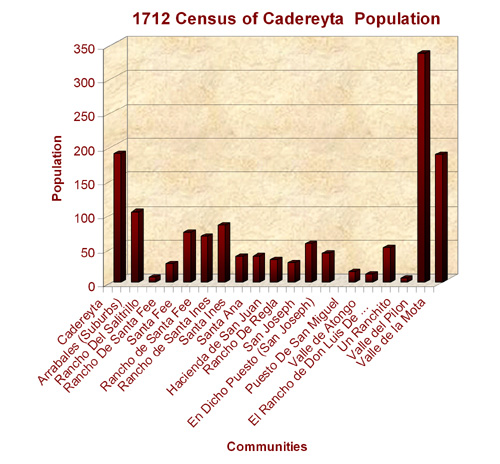
Chart 1. This chart presents the population distribution of Cadereyta and the surrounding communities from the 1712 Cadereyta census records. It is interesting to note that the majority of the population is in the last two communities (Valle Del Pilon and Valle De La Mota) which were largely composed of Indian servants. These servants were not listed by name, but simply counted as Indians of a particular tribe in the service of one of the Cadereyta citizens whose name is listed.
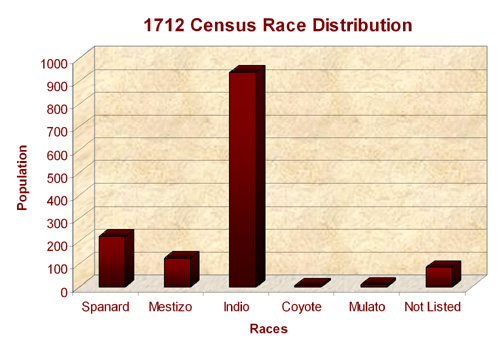
Chart 2. This chart, compiled from Guillermo Garmendia Leal 1712 Cadereyta census records, illustrates the race distribution of Cadereyta and the surrounding communities.
This genealogy book also describes the last re-founding of Cadereyta in 1763 and how the city was moved and set up. There is also a listing of the heads of families that participated in this move. The last section of this ancestry book describes over 450 families that came from Cadereyta and participated in the founding of towns in Tamaulipas (see table 2). Guillermo Garmendia Leal concludes his genealogy book with a bibliography of his sources.
| Date Founded | Town Name |
|---|---|
| 2/17/1749 | Santander (Jimenez) |
| 2/20/1749 | Burgos |
| 3/4/1749 | Camargo |
| 3/14/1749 | Reynosa |
| 3/19/1749 | San Fernando |
| 10/10/1750 | Revilla (Guerrero) |
| 3/6/1753 | Mier |
| 6/16/1765 | Cruillas |
Table 2. This table lists the founding dates and towns in Tamaulipas that were largely founded by former Cadereyta citizens.
In concluding this Hispanic genealogy book review, I would recommend this Hispanic genealogy book to anyone whose has or may have ancestors from Cadereyta Jimenez, Nuevo Leon, Mexico during the period covered (1635 – 1763). This genealogy book does not limit itself to a description the founders of Cadereyta or subsequent founding families of Tamaulipas towns. This genealogy book provides information on the founder’s descendants and the subsequent citizens of Cadereyta. This genealogy book also provides several ways to track the lifes of your ancestors through their civic and church participation. Because Guillermo Garmendia Leal chose to use several diverse ancestry sources for his genealogy book a person begins to get a feel for what it was like for our ancestors to have lived in this time and place. Finally, with the added ancestry and Cadereyta census this genealogy book includes, it is truly an indispensable resource for ancestry research in this area.
| Origen De Los Fundadores De Cadereyta (1635 – 1763), Guillermo Garmendia Leal, Monterrey, 131 pages, Copyright 1993, 131 pages. |